HelplineWorld24

This is default featured slide 1 title

Go to Blogger edit html and find these sentences.Now replace these sentences with your own descriptions.This theme is Bloggerized by Lasantha Bandara - Premiumbloggertemplates.com.

This is default featured slide 2 title

Go to Blogger edit html and find these sentences.Now replace these sentences with your own descriptions.This theme is Bloggerized by Lasantha Bandara - Premiumbloggertemplates.com.

This is default featured slide 3 title

Go to Blogger edit html and find these sentences.Now replace these sentences with your own descriptions.This theme is Bloggerized by Lasantha Bandara - Premiumbloggertemplates.com.

This is default featured slide 4 title

Go to Blogger edit html and find these sentences.Now replace these sentences with your own descriptions.This theme is Bloggerized by Lasantha Bandara - Premiumbloggertemplates.com.

This is default featured slide 5 title

Go to Blogger edit html and find these sentences.Now replace these sentences with your own descriptions.This theme is Bloggerized by Lasantha Bandara - Premiumbloggertemplates.com.

Wednesday, November 9, 2016

Brainteaser Interview Questions

A brainteaser is a form of puzzle that requires thinking in unconventional ways with given constraints in mind; sometimes it also involves lateral thinking. On a general scale, the most obvious answers are almost always the incorrect ones.
Brainteaser

Sample Brainteaser Interview Questions

Industry-Specific Interview Questions

Industry-specific questions are specific to the industry you are seeking employment in. These questions evaluate your educational skill sets, professional qualification, and employment experience, so prepare your answers after reviewing your performances, current assignments, and the achievements in projects that showcase your talent in the best possible way.
Industry-Specific
We have listed five industries with the most common questions asked in their industry-specific interview −

Administration

Customer Support

Information Technology

Finance

Accounting

Role-Play Questions

Role-plays are considered opportunities to prove that you possess all the key interpersonal skills you have mentioned in your resume. They help employers to assess how you'll react in certain situations. During a role-play, the interviewer assumes the role of a customer/client and asks you to sell him an idea or a product.
Questions like "why should I go with your company?" "What advantages can you offer me?" or "Why are your products so highly-priced when <rival company’s name> delivers the same products at such an inexpensive price?” are commonly asked.
Role-Play

Preparation

In role-play questions, it’s always advisable to have a detailed knowledge of the company beforehand. Collect as much information on the company’s policies, recent achievements, their closest competitors’ best-selling products, etc.

Teamwork

In some cases, the role-play may feature a group role-playing exercise. In these situations, try your best to be an efficient team-leader but don’t try to dominate. Try to get a balance between listening and speaking.

Composure

Be calm and composed under every situation. Don’t laugh or embarrass people who couldn’t satisfactorily participate in the role-play activity.

Sample Role-play Interview Questions

Case Study Interview Questions

Case study based interview questions are unique because answering them requires identifying the root causes and developing an action plan based on a logical analysis.
Case Study
In Case Interviews, interviewers tend to not mention important figures and details. They want to see if you have a clear idea on the industry and on what assumption you will solve the problem. In these situations, it’s okay to consider assumed data, but they need to be based on facts and logic.

Answering Case Interview Questions

Answering case interview questions can be tricky, especially when you don’t get the facts right. Do use the following tips to tackle such questions −
  • Listen carefully − Paraphrasing helps in understanding the question completely before answering.
  • Take time to think − Because of the sheer number of parameters needed to tackle the issue, candidates are expected to take some time to ponder on the scenario, however anything more than five minutes would be excessive.
  • Ask questions − Interviewers deliberately give incomplete questions to check the candidates’ understanding of relevant parameters, so they expect a lot of questions from you which makes the entire interview quite interactive.
  • Use a logical framework − Apply the principles you learned in business colleges as a framework. Examples include Porter's Five Forces and the SWOT analysis.
  • Prioritize objectives − Start addressing the most important objectives and concerns and gradually move towards relatively non-priority topics.
  • Try and think outside the box − Many interviewers are on the lookout for employees who can bring in creativity to their problem-solving process.
  • Exhibit enthusiasm − Behaving as though you feel it's fun to tackle this kind of problem is integral to showing how well you'd fit in as a consultant or whatever position you're interviewing for.

Standard Case Interview Questions

Market-Sizing Case Interview Questions

Market-Sizing Case Interview Questions need the candidates to guess the market size for a specific product. To answer these questions, you need to have a close idea on the population of the country, the male-female ratio, different demographics, among many other parameters. A few popular examples are −
Q. How many light bulbs are there in Delhi?
Q. How many people read gossip magazines in Mumbai?
Q. How many photocopies are taken in Odisha each year?
Q. How much beer is consumed in the city of Chandigarh?

Business Case Interview Questions

These questions need knowledge on the internal working of a company. Visit their website and collect as much information as possible on their way of operations.
Q. You are working directly with <company’s name>management team. It is organizing a project designed to increase the revenue significantly. If you were provided with data and asked to supervise the project, what steps would you take to ensure its success?
Q. The firm has assigned you to consult <company’s name>intending to drop a product or expand into new markets in order to increase revenue. What steps would you take to help this company achieve its objective?
Q. You have been assigned to consult <shoe retailer’s name>with stores throughout the nation. Since its revenue is dropping, the company has proposed to sell food at its stores. How would you advise this client?

Logic Problems

Questions involving logic problems require you to be able to perform numeracy quickly. The following are a few logic problems.

General Interview Questions

Compared to Behavioral Questions that deal with your situation-handling in a past scenario, Traditional or General Interview Questions tend to be more hypothetical. They can be asked in any interview and they don’t specifically cater to any particular job responsibility.
General Interview questions
It is always advisable to memorize a few keywords on the company’s needs, problems, or goals. Make sure you visit the company’s website before the interview to uncover the needs of this specific job profile, instead of the generalized needs of the industry.

Sample General Interview Questions

Behavioral Questions

It is estimated that 80% of the interview is made up of behavioral questions. This type of interviewing is based on the philosophy that a detailed analysis of the way you acted in certain circumstances in your previous job will give a reliable indication of the way you will act in your new job too.
Behavioral
Behavioral questions will be experience-based and you need a lot of practice to be able to answer them in a satisfactory manner.

STAR Technique

To answer Behavioral Questions, employ the STAR technique −
  • S = Situation − (recall an incident in your life that suits the situation)
  • T = Task − (recall an incident in your life that suits the task)
  • A = Action − (mention the course of action you opted to address the situation or task)
  • R = Result − (mention the result of your action and the outcome)


Remember that these are only sample interview answers meant to give a general idea on the approach to Behavioral Interviews. You need to formulate your own answers to suit the context and scenario asked in the question.

Sample Behavioral Interview Questions


HR Interview Questions


HR Interview Questions

An interview can be broadly seen as a formal meeting arranged to evaluate a prospective employee by obtaining his/her career-oriented details, like qualification and work-experience. An interview presents the applicants an opportunity to elaborate on certain components of their resumes and talk about their areas of expertise. It also tests their ability to think critically and independently.
Depending on the position and the company you are getting hired for, you might need to appear in various types of interviews. We going to discuss here the following six types of interviews and also see what makes them so unique −
  • Behavioral Questions
  • Traditional Questions
  • Case Questions
  • Role-play questions
  • Industry-specific questions
  • Brainteasers

HR Interview Questions Tutorial

An interview is a conversation between two or more people where questions are asked by the interviewer to elicit facts or statements from the interviewee. This is a useful tutorial that collects a set of most useful HR interview questions and how to answer them in a tactful manner.

Audience

This tutorial is designed primarily for young adults and job-seekers who want to understand the essential steps for getting success in interviews.

Prerequisites

Before proceeding with this tutorial, you are expected to be open to asking questions and resolving any further queries on the topic by contacting us.

SEO Techniques Summary

We have covered almost all major concepts related to Search Engine Optimization. Now you are familiar with most frequently used SEO related terminologies as well.
You have learnt how to optimize keywords, title, alt, metatags, anchor, and other text from the viewpoint of SEO. You also have learnt the importance of having good content in your website. In the Miscellaneous Techniques chapter, we have suggested you other important points which will help you optimize your website.
In a nutshell, we can have the following points as the ethical strategies for achieving optimal ranking in the search engines:
  • All pages must conform to W3C standards.
  • Keyword density is never abusive.
  • Always include: robots.txt, sitemap.xml, and urllist.txt.
  • Keywords are prominent in the Title, Metatags, and Headings.
  • ALT tags and Title tags are not forgotten.
  • Nomenclature is fundamental to being indexed.

SEO - Miscellaneous Techniques

There are various other tips related to SEO. We have not categorized them into any special category and hence, putting these in miscellaneous category. Go through these tips one by one.

To-Don't List

  • Don't keep hidden text on your webpages.
  • Don't create alternate image spamming by putting wrong keywords.
  • Don't use meta tags stuffing.
  • Don't use frames and flash on your site.
  • Don't exchange your links with black listed sites.
  • Don't try to fool your site visitors by using misspelled keyword.
  • Don't send spam emails to thousands of email IDs.
  • Don't use too much graphics on your site.
  • Don't create too many doorway pages.
  • Don't try to create duplicate content of pages.
  • Don't submit your website many times in a single search engine.
  • Don't use sub-directory depth more than 1-2.
  • Don't create too many dynamic pages. Try to convert them into static pages.
  • Don't bloat your pages with code.
  • Don't nest your pages.

To-Do List

There are various other tips which can help you to optimize your website for many search engines.
  • Create logs of pages and each page should however contain a minimum of about 200 visible words of text to maximize relevance with Google.
  • Create a Sitemap, Help, FAQ, About Us, Link to Us, Copyright, Disclaimer, Privacy Policy pages on mandatory basis.
  • Create a homepage link to each and every webpage and provide easy navigation through all the pages.
  • Pay attention to your dynamic page URLs. Google can crawl and index dynamic pages as long as you don't have more than 2 parameters in the URL.
  • Check your complete site for broken links. Broken links will reduce your other pages rank as well.

Mobile SEO Techniques

Millions of users these days access the web using smartphones running on Android, iOS, or Windows. Hence, it has become imperative that websites adapt themselves to this changing environment and make suitable changes in their website design to attract more viewership.
The desktop version of a site might be difficult to view and use on a mobile device. The version that is not mobile-friendly requires the user to pinch or zoom in order to read the content. Users find this a frustrating experience and are likely to abandon the site. In contrast, a mobile-friendly version is readable and immediately usable.
A recent Google update makes it mandatory that a website should be mobile-friendly to be effective on Mobile Search Engines. Note that a website that is not mobile-friendly will not have any impact on regular search engines either.
In this chapter, we will see how to make a website mobile-friendly in order to ensure the visitors who access the website from mobile devices have an optimized experience.

What is Mobile SEO?

Mobile Search Engine Optimization is the process of designing a website to make it suitable for viewing on mobile devices of different screen sizes having low bandwidth. Apart from following all the SEO rules which are applicable to a desktop website, we need to take additional care while designing a website for mobile devices. A website is mobile friendly if it has the following attributes −
  • A good mobile website has a responsive design which performs well on desktops as well as mobile devices. It not only reduces the maintenance of the website but also makes the content consistent for the search engines.
  • The contents of a good mobile website are easy to read on a mobile device without having to zoom the screen. It has appropriate fonts, colors, and layouts.
  • It is easy to navigate through a good mobile website on a small screen. It provides links and buttons that can be easily maneuvered using a finger.
  • A good mobile website is lightweight such that it takes less bandwidth and time to load on mobile networks.
  • The Home Page of a mobile website plays the most important role in connecting users to the content they are looking for. Therefore, good mobile websites make sure the most important links are displayed on the Home Page so that they get enough visibility.
The ranking of a website depends heavily on how user friendly it is. You can follow the guidelines given below to design a great mobile-friendly website.

Optimize Your Site for Mobile

If your site is already optimized for search engines, then it should not be too difficult to optimize it for mobile devices. First, let us understand what it takes to go mobile. We can categorize the steps into three broad categories −
Step 1 − Select a Mobile Configuration
Step 2 − Inform Search Engines
Step 3 − Avoid Common Mistakes

Select a Mobile Configuration

There are three different mobile configurations that you can choose from −
Step 1 − Responsive Web Design
Step 2 − Dynamic Serving
Step 3 − Separate URLs
Each has its own advantages and disadvantages. Google recommends responsive design, however it supports all three configurations. The following table shows how the mobile configuration affects your URL and HTML code −
Mobile ConfigurationURLHTML
Responsive Web DesignStays the sameStays the same
Dynamic ServingStays the sameDifferent HTMLs
Separate URLsDifferent URLsDifferent HTMLs

Responsive Web Design

Google recommends responsive web design become it is the simplest mobile configuration and very easy to implement. It serves the same HTML code on the same URL, however it adjusts the display based on the screen size of the mobile device.
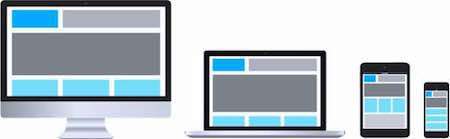
Responsive Web Design

Dynamic Serving

Dynamic serving is a type of mobile configuration where the URL of your website remains unchanged, but it serves different HTML content when accessed from a mobile device.
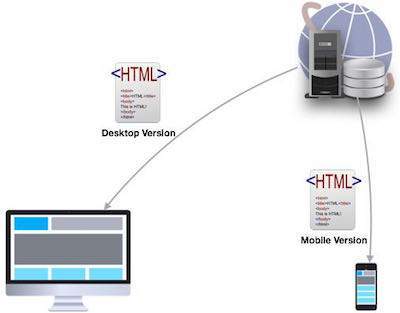
Dynamic Serving
When your content is dynamically served from the server, make sure you inform Google that the content it is crawling may look different on mobile devices. A major drawback of this approach is that you will have to do additional processing on your content at the server level before severing it to the user. This approach puts unnecessary load on your server and makes it slow.

Separate URLs

When you maintain two different URLs — one for mobile users and another for desktop users – make sure you inform Google explicitly when to serve which version. Google does not recommend separate URLs because it can detect automatically that your mobile pages are different from your desktop pages.
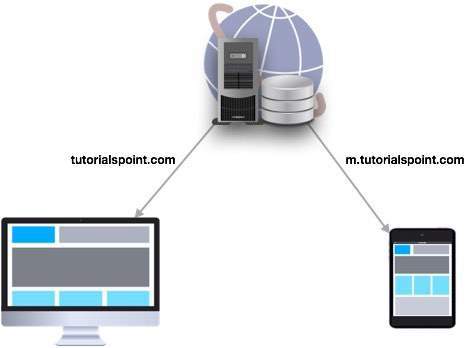
Different URLs
This approach is not practical when you have a big website because maintaining two versions of the same website will require double the effort and money. At the same time, you cannot avoid various discrepancies in your content while maintaining two versions.
From the viewpoint of SEO, each URL performs separately. Hence your desktop ranking will never be added to the mobile ranking and they will always be assumed as separate websites. We don’t recommend maintaining different URLs for mobile and desktop versions if you want to draw the benefits of SEO.

Inform Search Engines

Make sure Google and other search engines understand your mobile configuration. Most important of all, Google must understand your page so that it can rank your website properly. How you inform Google depends on which mobile configuration — responsive web design, dynamic serving, or separate URLs — you have opted for.
In case your site has a responsive design, Google’s algorithms can understand it automatically without you having to inform Google. When you have a responsive design, just make sure you have the following meta-tag in your webpage header −
<meta name="viewport" content="width=device-width, initial-scale=1.0">
The viewport decides how your webpage will be displayed on a device. A site with responsive design varies its size based on the size of the device screen. Declare a viewport so that your webpage displays correctly on any device.
If your website is dynamically served, make sure you allow Google detect your configuration using the Vary HTTP header −
Vary: User-Agent
The Vary header is important to tell the search engines that different content will be served on desktops and mobile devices. This header is really important when your content is served by any cache system like a Content Delivery Network and those systems will make use of this header while serving content on different devices.
In case you maintain separate URLs, e.g., example.com and m.example.com, then you can inform Google by adding a special link rel=alternate tag in your desktop version and vice versa as follows.
Desktop page should have following in its header:
<link rel="alternate" media="only screen and (max-width: 640px)"
href="http://m.example.com" >
Mobile page should have following in its header:
<link rel="canonical" href="http://www.example.com" >

Avoid Common Mistakes

In order to optimize your website for mobile devices, make sure you avoid committing the following mistakes −
  • Slow Mobile Pages − Mobile networks are slower as compared to wired Internet networks, so it is important to pay attention to how fast your mobile pages load. It is a critical Google ranking factor. Use a mobile SEO tool to find out your mobile page speed. Google provides a number of good tools that you can use. Browse the following link −https://www.google.com/webmasters/tools/mobile-friendly/
  • Don't Block CSS and JavaScript − Google recommends to use inline CSS and Javascripts for mobile friendly websites so that they can be downloaded along with the content. So if you don’t have much CSS, then try to adjust it within the tag itself; but if you are using a lot of CSS in separate files, then try to include it at the bottom which will stop blocking the other content being downloaded. The same rule applies to Javascript, which can be kept inside the page itself or included at the bottom of the page. If you can avoid including the file at the top of the page, then make use of async attribute while including them.
<script async type="text/javascript" src="jquery.js"></script>
  • Mobile Redirects − Since mobile networks are normally slow, too many redirects can hurt your page speed. If you are maintaining multiple URLs, make sure all your links point to the relevant pages. In case you maintain multiple URLs and you recognize a user is visiting a desktop page from a mobile device and you have an equivalent mobile page at a different URL, then redirect the user to that URL instead of displaying a 404 error.
  • Heavy Images − Heavy images increase the load time, however we cannot completely get rid of them since they are useful and effective. Therefore you should maintain a good balance between text and heavy images. Use a good tool to optimize your images and save them at low resolution to avoid heavy downloads.
  • Avoid plug-ins and pop-ups − Plug-ins like Flash and Java may not be available on user’s mobile device. Always ensure you don’t have any unplayable content on your mobile page. Avoid using pop-ups on mobile pages because it becomes quite clumsy to close these pop-ups on a mobile device.
While creating a mobile page, always keep in mind that the user has limited space to work on. So, you need to be as concise as possible while creating titles, URLs, and meta-descriptions – of course without compromising the essence or quality of information.

Useful Tools

Here is a list of some useful tools that you can use to find out how mobile friendly your site is −
  • Google Webmaster Tools − Use the available Google tools and techniques to understand what should be used and what should be avoided while designing desktop as well as mobile websites.
  • Mobile Emulator − It lets you see how your site appears on a wide variety of mobile devices.
  • Moz Local − Use this tool to ensure that your local SEO is in order.
  • Responsive Web Design Testing Tool − Use this tool to see how your responsive site looks like on a variety of mobile devices with different standard screen sizes.
  • Screaming Frog − This is a useful tool that allows you to analyze your site and double-check all the redirects.
  • User Agent Switcher − This is a Firefox add-on that you can use to find out how your site looks like when accessed from a different user agent.